
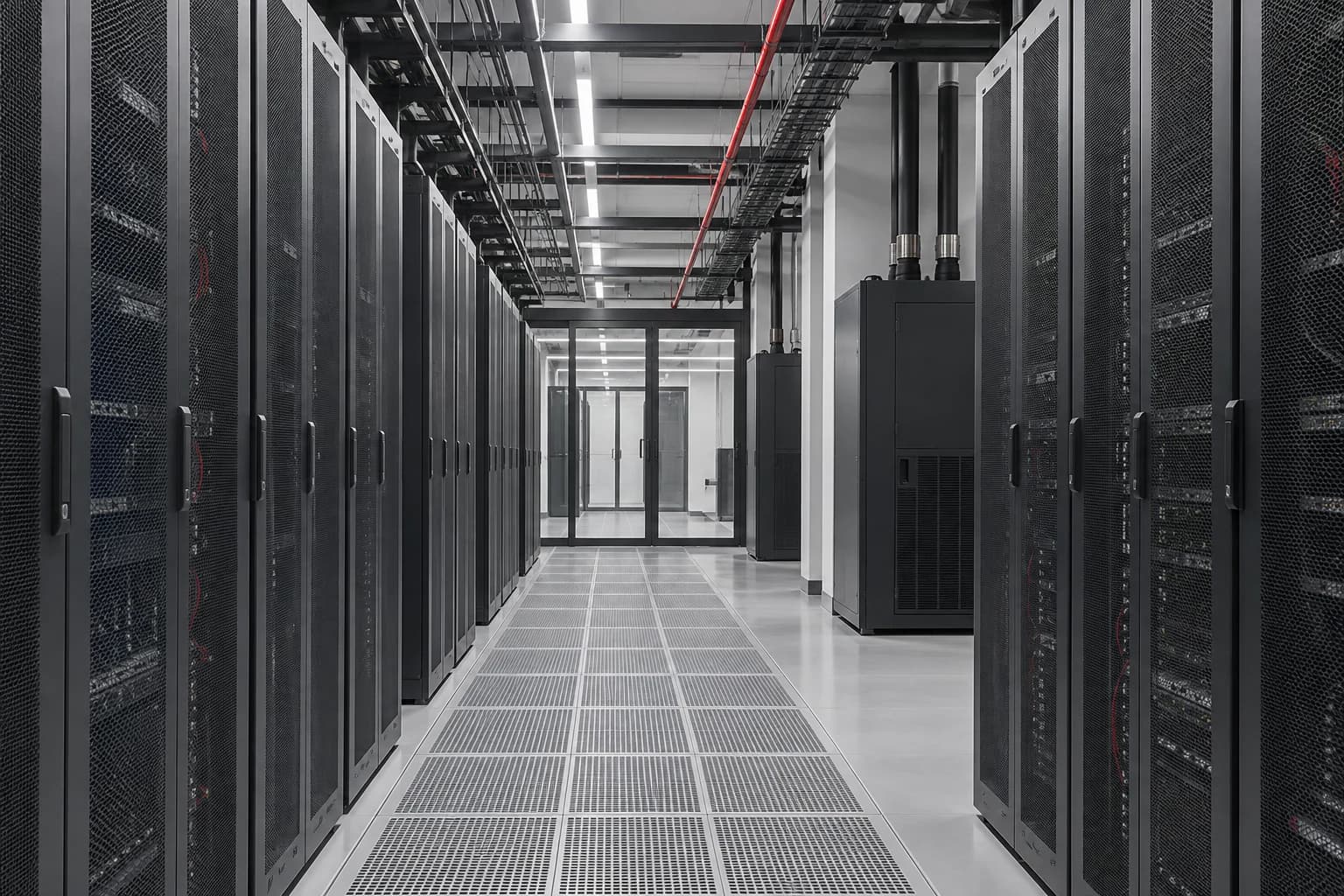
Data Center Infrastructure
Engineered for Tier III/IV hyperscale and high-density AI computing facilities. Delivering 2N fault-tolerant distribution, high-frequency modular UPS systems, medium-voltage DC busways, hot/cold aisle containment, and variable-capacity in-row cooling.
Overview
1. High-Density Computing and Modern Data Center Infrastructure Bottlenecks
Accelerated by large AI training clusters and mission-critical cloud services, power density per server rack is escalating rapidly from legacy 4kW~8kW ratings to 20kW~50kW, even exceeding 100kW in direct-to-chip liquid-cooled architectures. High heat dissipation and transient step-load surges place unprecedented physical stress on upstream switchgear, distribution busways, and continuous thermal cooling systems.
Conventional fragmented equipment architectures suffer from extensive cabling losses, low conversion efficiency, and large physical footprints. They can no longer satisfy strict compliance demands for PUE ≤ 1.15 and 99.999% ('five nines') operational availability.
2. Standard System Architecture: 2N Fault-Tolerant Power and Aisle Containment
Standard engineering practice for modern data center deployments relies on the following infrastructure architectures:
2N Dual-Bus Concurrent Maintainability: Full physical isolation from medium-voltage inputs down to Row Power Distribution Units (RPDUs). Static Transfer Switches (STS) achieve transfer times ≤4ms, enabling scheduled maintenance or equipment upgrades without interrupting dual-cord server operations.
Modular Online High-Frequency UPS and HVDC Options: Deploying high-frequency modular UPS units (power density up to 50kVA/3U, efficiency reaching 97.5%) or direct 240V/336V DC busway architectures that eliminate redundant inverter stages, connecting backup battery banks directly to the DC bus for millisecond-level outage protection.
Aisle Containment Integration: Integrating standard 19-inch racks, In-Row precision cooling units, smart PDUs, and containment roof panels with fire-alarm drop linkages, completely eliminating hot air recirculation and boosting cooling airflow efficiency by over 35%.
3. Core Equipment Bill of Materials and Electrical Parameters
Verified electrical specification criteria required for project procurement:
Modular Online Double-Conversion UPS: Input power factor > 0.99, total harmonic distortion (THDi) < 3%, operating efficiency of 96.5%~97.5% across 20%~80% typical operational load bands, with full hot-swappable module scalability and N+X redundancy;
In-Row Variable-Speed Inverter Air Conditioners: Equipped with DC variable-frequency scroll compressors and EC centrifugal fans, achieving a Sensible Heat Ratio (SHR) ≥ 0.95 and supporting integrated economizer free-cooling to lower mechanical compressor hours;
Smart Lithium (LiFePO4) Battery Energy Storage: High-density rack-mounted lithium battery cabinets with 3-tier BMS protection, dynamic internal cell balancing, individual branch breakers, and thermal runaway containment;
DCIM Environmental Telemetry: Native industrial communication over SNMP V3, Modbus-TCP, and BACnet, monitoring cabinet-level temperature/humidity sensors, harmonic distortions, battery cell impedance, and access security.
4. Global Turnkey Delivery and Engineering Commissioning Support
RICEWIND manages a resilient international supply chain for mission-critical infrastructure, providing global engineering contractors with load profiling, Single Line Diagram (SLD) validation, factory witness dummy-load burn-in testing, and international logistics delivery.
Engineering consultation and bulk procurement inquiries: Email: lee@ricewind.com | WhatsApp: +86 17621197907.