
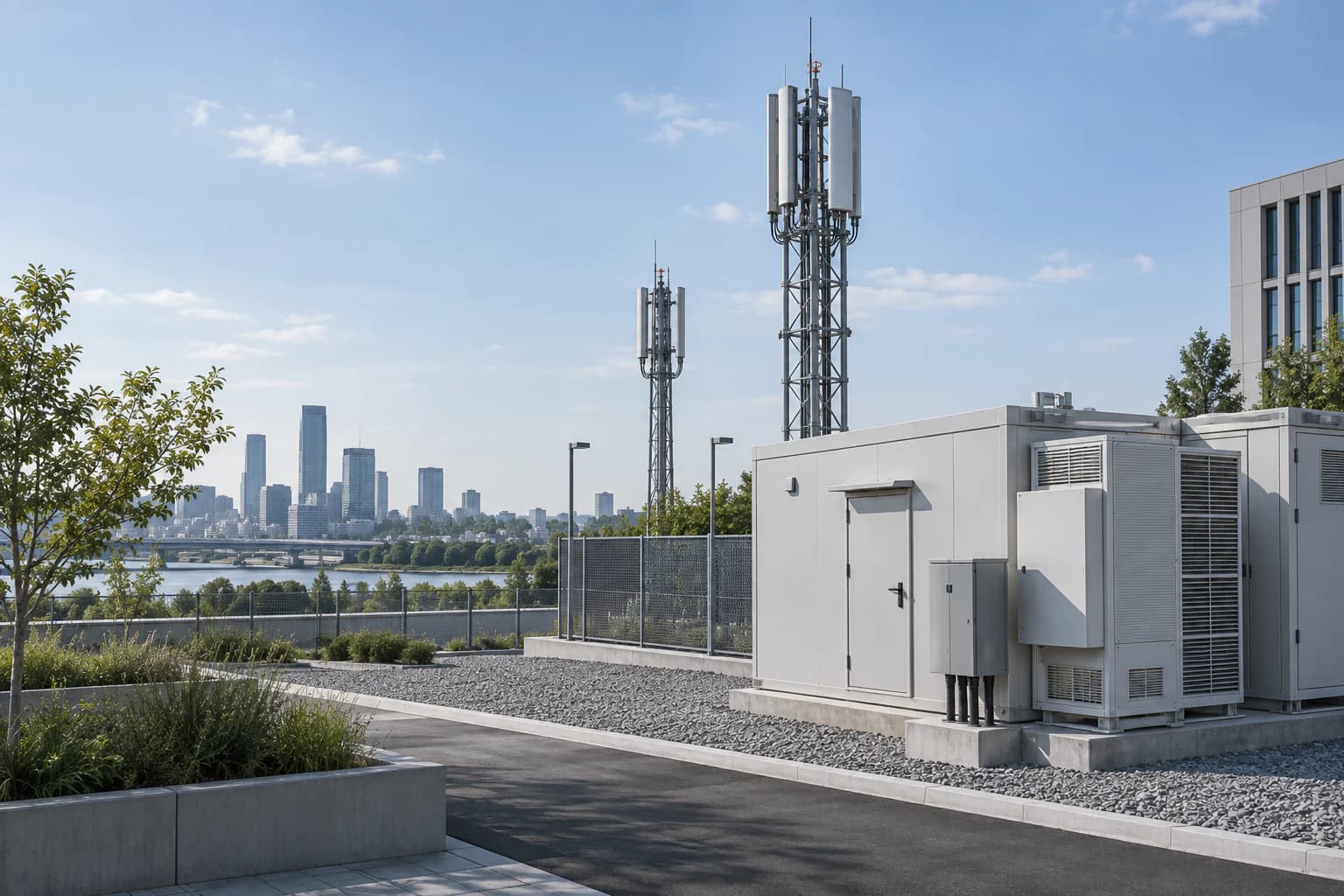
Telecommunications and 5G Networks
Designed for 5G macro towers, micro sites, transmission rooms, and off-grid telecom hubs. Providing -48V DC switch-mode power systems, Titanium-grade rectifiers, dual-stage LLVD/BLVD disconnection, smart lithium peak-shaving, and IP55 weather-resistant enclosures.
Overview
1. 5G Macro Site Power Surges and Harsh Environmental Challenges
The deployment of 5G Massive MIMO active antenna units (AAUs) and baseband processing pools (BBUs) increases base station power consumption to 4kW~8kW per site, far exceeding legacy 3G/4G allocations. Many existing cell towers face severe grid transformer limits, AC cabling constraints, and degraded battery reserve autonomy.
Furthermore, global telecom installations often operate in harsh coastal salt-spray environments, desert climates exceeding +55°C, or sub-zero tundra regions down to -40°C. Extreme temperatures and humidity risk rectifier thermal derating, condensation, and corrosion, placing rigorous demands on cabinet ingress protection and thermal control.
2. Standard System Architecture: High-Density DC Power and Dual-Stage LVD
Field engineering standards for modern telecom site deployments typically employ the following power architectures:
-48V High-Density Embedded Subracks: Standard 19-inch rack enclosures (2U to 5U) delivering 120A to 400A DC output. Rectifier conversion efficiencies exceed 96% (Titanium rating), minimizing internal cabinet thermal dissipation.
Intelligent Dual-Stage Low Voltage Disconnection (LLVD / BLVD): During prolonged utility grid outages, the LLVD contactor sheds non-critical auxiliary loads first. When cell voltages reach critical thresholds (e.g., 43.2Vdc), the BLVD contactor isolates primary transceivers and battery strings, preventing deep discharge damage.
Peak Shaving with Smart Lithium Energy Storage: Dynamically capping utility intake thresholds via controller software. During daytime peak traffic, lithium battery banks discharge automatically to shave the peak, eliminating costly utility transformer upgrade fees.
3. Core Equipment Bill of Materials and Electrical Parameters
Standardized specification matrix for telecom turnkey procurement:
Switch-Mode Rectifier Modules: Ultra-wide AC input range (85VAC to 300VAC), maintaining ≥96% efficiency across 30%~80% operational loads, with CAN-bus digital current sharing and live hot-plugging;
Surge Protective Devices (SPD): Class C AC surge protection (20kA nominal, 40kA impulse 8/20µs) paired with fine DC surge suppressors and dry-contact alarm reporting;
IP55 Weatherproof Outdoor Cabinets: Heavy-duty galvanized steel or insulated sandwich panels coated with UV-resistant powder coating (≥1000h salt spray resistance), equipped with DC heat exchangers or climate air conditioners;
Central Supervisory Units (CSU): Equipped with LCD displays, Ethernet interfaces, SNMP V2/V3 telemetry, and northbound telecom OSS integration, monitoring AC/DC metrics, temperature, and door-access alarms.
4. Global Telecommunication Field Experience and Delivery
RICEWIND supplies telecommunication operators and tower companies across CIS, the Middle East, Southeast Asia, and Africa with verified power subracks, pre-configured distribution, and fully integrated outdoor enclosures.
Telecom procurement inquiries and custom subrack engineering: Email: lee@ricewind.com | WhatsApp: +86 17621197907.