
KVM8048 Equipment information & support
The Vertiv KVM8048 is a carrier-class 48-port KVM over IP matrix switch engineered for mission-critical hyperscale data centers and command centers. Supporting multiple concurrent remote users, non-blocking hardware-accelerated HD video over IP, virtual media redirection, and dual redundant power feeds, it guarantees uninterrupted BIOS-level access.
Equipment information
- Brand
- Vertiv
- Equipment model
- KVM8048
- Equipment type
- KVM systems
- Controller / software version
- Confirm against the installed equipment
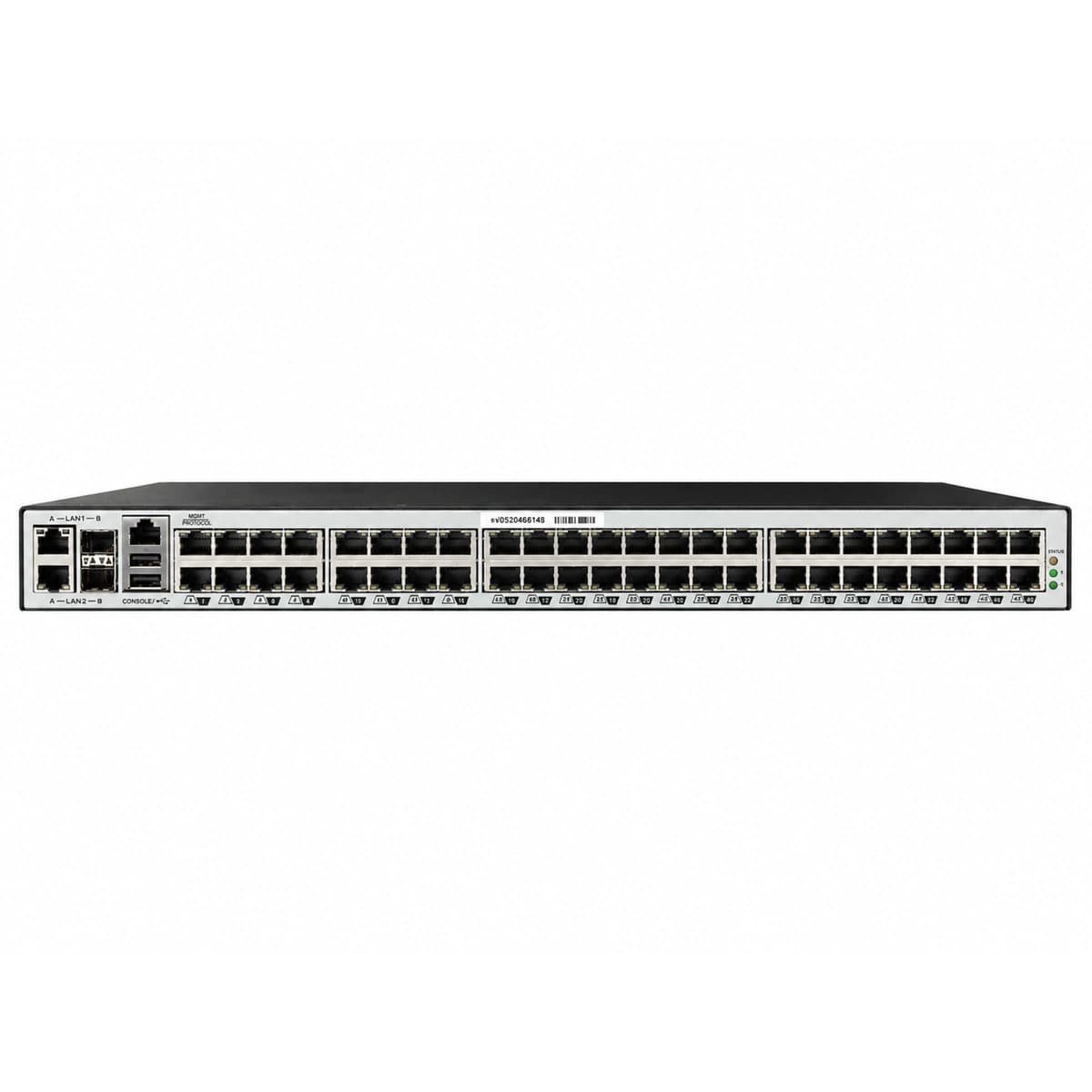
Information below comes from the current product catalogue. Confirm the controller, software version and configuration of the installed equipment separately.
- Target Server Ports
- 48x RJ45 High-Density Server Ports
- Concurrent Remote User Sessions
- 4 to 8 Independent IP Concurrent Users
- Power Supply Architecture
- Internal Dual Redundant AC Supplies (Dual C14)
- Virtual Media & CAC Support
- True Virtual Media (ISO Mounting) & CAC Reader
- Physical Dimensions
- 44 (1U) × 434 × 340 mm
- Network Interfaces
- Dual 10/100/1000Mbps Auto-Sensing Failover
Alarms & troubleshooting
Access Complete Maintenance & Full Alarm Troubleshooting Manual
This page lists high-frequency critical alarm codes commonly encountered in field maintenance. Comprehensive manufacturer troubleshooting matrices, board-level repair guides, detailed electrical schematics, and firmware commissioning manuals are delivered alongside equipment upon formal project procurement, accompanied by dedicated FAE technical support.
Share on-site information
- 01
Identify the exact model
Record the nameplate, system model and controller or module model.
- 02
Keep the alarm details
Record the full alarm text, indicator colour, timing and whether it persists.
- 03
Describe recent changes
Note recent replacements, software updates or configuration changes.
Record information visible in the existing interface. Electrical measurements, disassembly and replacement should follow the applicable manufacturer's manual and be performed by qualified personnel.
Related technical articles
Browse the technical guides or send a question about this model.
View all articlesNeed a replacement module or supporting equipment?
Confirm the full model, system configuration and compatibility requirements before enquiring about suitable products.
Have a model and an on-site issue?
Share the exact model, alarm text and observed symptoms to help identify relevant information and compatibility requirements.