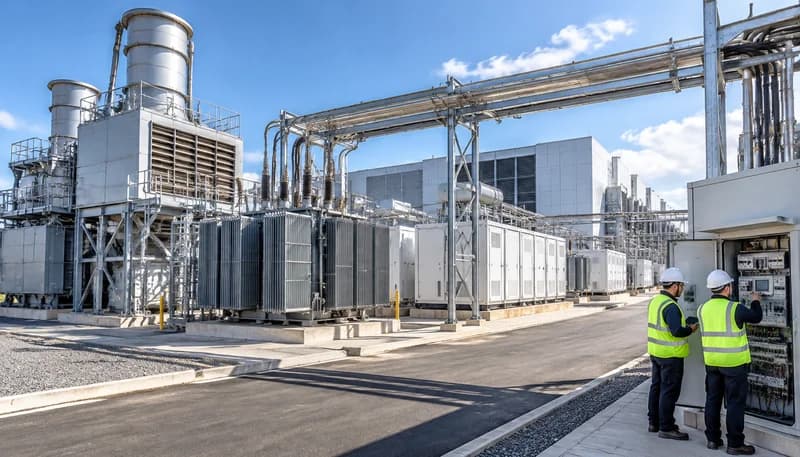
The 24% CAGR Power Deficit: Modeling the Structural Mismatch Between AI Compute Trajectories and Utility Interconnection Queues
Hyperscale computing architecture is undergoing an unprecedented structural inflection. Driven by the training and inference demands of frontier large language models, enterprise data center electricity demand is projected to expand at a compound annual growth rate of 24% through 2030. However, the physical reality of the electrical utility grid cannot accommodate this trajectory within conventional development cycles. While modern hyperscale shell construction and IT deployment require approximately 18 to 24 months, utility interconnection queues across major Regional Transmission Organizations—including PJM, ERCOT, CAISO, and MISO—now average 4 to 7 years for transmission-level service requests exceeding 100 MW. The regulatory implementation of FERC Order 2023, while designed to penalize speculative queue positioning through clustered study schedules, has temporarily exacerbated engineering throughput delays at transmission planning desks.
Compounding this timeline divergence is the fundamental shift in electrical load profiles. Traditional enterprise workloads presented stable, highly predictable baseload characteristics with gradual diurnal swings and continuous power factors between 0.95 and 0.98. In contrast, massive artificial intelligence clusters—drawing between 100 MW and 500 MW across consolidated campuses—exhibit dynamic step-load transients, severe harmonic distortion, and abrupt phase shifts. When transmission capacity is constrained by regional thermal limits and localized N-1/N-2 contingency violations, utilities increasingly deny firm transmission access or mandate curtailment-heavy non-firm interconnections. To preserve delivery schedules, mission-critical infrastructure architects must decouple their facilities from utility dependence, deploying behind-the-meter (BTM) islanded power architectures capable of sustaining 0.999999% (six nines) electrical availability.
Model Regional Transmission Organization (RTO) queue attrition rates and cluster study timelines using probabilistic Monte Carlo risk frameworks.
Reconcile timeline deltas by establishing parallel development paths: 18-month IT deployment timelines decoupled from 5-7 year utility grid transmission upgrades.
Design campus electrical distribution architectures to N-2 redundancy standards to maintain 0.999999% uptime independently of bulk electric system availability.
Long-Lead High-Voltage Substation Bottlenecks: Mitigating 120-150 Week Transformer Deliveries and EPC Execution Constraints
The primary mechanical bottleneck stalling conventional high-voltage substation delivery resides in the global supply chain for Extra High Voltage (EHV) power transformers and autotransformers. Factory lead times for 138kV, 230kV, 345kV, and 500kV step-down transformers have lengthened from an historical baseline of 40 to 52 weeks to an unprecedented 120 to 150 weeks. This critical path constriction is driven by severe production ceilings for Grain-Oriented Electrical Steel (GOES), shortages of specialized insulating paper, limited domestic manufacturing capacity for specialized high-voltage bushings, and a global scarcity of skilled transformer winding technicians. Simultaneously, Engineering, Procurement, and Construction (EPC) firms face systemic labor and equipment deficits, rendering traditional on-site high-voltage substation builds incapable of tracking hyperscale commissioning horizons.
Mitigating these procurement and construction constraints requires a fundamental departure from custom engineer-to-order substation paradigms. Microgrid strategists must implement fleet-standardized high-voltage configurations, standardizing on common core-and-coil frames—such as modular 80/100/133 MVA OA/FA/FA step-down units equipped with dual-secondary windings—allowing assets to be interchanged across diverse geographical nodes. Furthermore, developers must shift from open-air insulated substations to pre-commissioned, modular 34.5kV Gas-Insulated Switchgear (GIS) or hybrid switchgear enclosures. By securing rolling supplier production slots 24 to 36 months ahead of final campus electrical design and utilizing factory-assembled skid architectures, EPC on-site installation timelines can be compressed by up to 40%.
Standardize transformer procurement specifications (e.g., 345kV/34.5kV or 138kV/34.5kV with standardized impedance Z% = 8-10%) to enable multi-project interchangeability.
Secure rolling production slots for GOES core manufacturing and high-voltage circuit breakers 24 to 36 months prior to site groundbreaking.
Transition switchyard engineering from field-erected air-insulated systems to skid-mounted, factory-tested 34.5kV GIS modules to compress civil and electrical critical paths.
Behind-the-Meter Prime Generation: Engineering Aeroderivative Gas Turbines, RICE Fleets, and Fuel Cells for Islanded Base-Load
Operating an islanded hyperscale data center requires behind-the-meter prime power assets capable of providing continuous baseload while simultaneously delivering dynamic load-following capability. The optimal generation portfolio combines distinct thermodynamic machine classes: aeroderivative gas turbines, medium-speed reciprocating internal combustion engines (RICE), and solid oxide fuel cells (SOFC). Aeroderivative turbines (e.g., 30MW to 50MW frames derived from aviation platforms) offer exceptional power density, fast cold-start sequences (<10 minutes to full load), and ramp rates exceeding 50 MW per minute, making them ideal for the primary power block. However, their simple-cycle heat rate degrades substantially under part-load conditions, necessitating complementary assets.
To optimize multi-megawatt campus heat rates and enhance system availability, engineering designs deploy hybrid generation topologies. Natural gas-fueled RICE fleets (typically 5MW to 18MW per unit) operate in an N+2 redundancy configuration to handle dynamic sub-hourly baseload shifts with electrical efficiencies exceeding 45% to 48%, relatively unaffected by ambient temperature variations or part-load operations. For sustainable baseload, modular Solid Oxide Fuel Cells (SOFC) are increasingly integrated at the 34.5kV collector ring to deliver high electrical efficiency (55% to 60%) with near-zero criteria pollutants. All prime generators must step up from nominal generation voltages (typically 11kV or 13.8kV) via dedicated Generator Step-Up (GSU) transformers into a synchronized 34.5kV medium-voltage ring distribution system governed by isochronous speed and voltage controllers.
Engineer a balanced generation mix deploying aeroderivative gas turbines for high-density prime capacity alongside modular RICE units for part-load efficiency.
Design 13.8kV to 34.5kV generator step-up transformers with low impedance (Z% = 7-9%) to balance short-circuit current suppression and transient voltage recovery.
Specify dual-fuel capabilities (natural gas with liquid fuel backup) with automated on-the-fly transfer systems to safeguard against fuel supply pressure collapses.
Grid-Forming BESS and Dynamic Load Smoothing: Absorbing Sub-Second 100MW+ GPU Training Inrush Transients
Modern artificial intelligence training workloads introduce high-frequency power transients that violate the mechanical stability limits of conventional thermal generation. During distributed training, synchronous GPU collective communications (e.g., AllReduce algorithms) and model checkpointing trigger near-instantaneous load steps, swinging power consumption from 10% to 100% of cluster capacity within 10 to 50 milliseconds. When aggregate campus loads drop or surge by 50 MW to 150 MW in sub-second intervals, traditional synchronous turbine governors and turbocharger wastegates cannot react with sufficient speed. This discrepancy induces extreme rates of change of frequency (RoCoF > 2.0 Hz/s) and severe bus voltage excursions, risking catastrophic under-frequency load shedding (UFLS) or machine tripping.
To insulate prime generation from these severe dynamics, the 34.5kV microgrid must integrate utility-scale Battery Energy Storage Systems (BESS) equipped with Grid-Forming (GFM) inverter topologies. Operating under Virtual Synchronous Machine (VSM) or droop-based control algorithms, GFM inverters do not rely on an external voltage reference; instead, they establish the voltage vector and phase angle directly. With sub-cycle active response latencies under 4 milliseconds, GFM BESS injects or absorbs active and reactive power instantly to damp RoCoF, stabilizing the synthetic inertia profile of the island. Fully compliant with IEEE 2800 standards, these containerized 2C-to-4C lithium-iron-phosphate (LFP) systems absorb the high-frequency GPU dynamics, allowing thermal generators to ramp smoothly within their optimal mechanical limits.
Deploy Grid-Forming (GFM) inverters operating on Virtual Synchronous Machine (VSM) algorithms with sub-cycle active power response (<4 milliseconds).
Dimension BESS power and energy capacity (typically 2C-4C ratings, 15-30 minute duration) to decouple high-frequency GPU step loads from turbine governor response curves.
Enforce IEEE 2800 technical compliance for fast fault current injection, dynamic reactive power support, and precise phase-jump tracking across the 34.5kV collector.
Fuel Supply Resiliency and Environmental Compliance: Natural Gas Linepack Hydraulics, SCR De-NOx Towers, and CEMS Telemetry
Operating multi-hundred-megawatt on-site generation requires absolute fuel supply assurance combined with stringent emissions mitigation. Natural gas supply pipelines must be modeled under transient dynamic conditions; sudden turbine ramp-up events demand massive volumetric surges that can rapidly deplete local pipeline linepack pressure below minimum operational thresholds (typically 400 to 800 psig). Engineers must execute transient Navier-Stokes pipeline hydraulic simulations to determine linepack depletion rates during peak operational profiles. To mitigate pipeline curtailment or regional pressure collapses, campuses must incorporate dedicated on-site high-pressure fuel buffer vessels, high-pressure compressed natural gas (CNG) storage cascades, or localized liquefied natural gas (LNG) regasification terminals capable of supplying full baseload for 48 to 72 hours.
Simultaneously, environmental permitting under Clean Air Act Title V regulations dictates aggressive emissions control boundaries. Prime natural gas generation running continuously in islanded or grid-interactive configurations must meet stringent oxides of nitrogen (NOx) performance limits, typically constrained to 2.0 to 9.0 ppmvd (parts per million by volume, dry basis, corrected to 15% O2). Achieving this performance requires integrating multi-stage exhaust gas treatment towers featuring Selective Catalytic Reduction (SCR) with aqueous ammonia or urea injection, coupled with carbon monoxide (CO) oxidation catalysts. Continuous Emissions Monitoring Systems (CEMS) must be directly coupled via high-speed deterministic protocols to the microgrid SCADA system, dynamically derating or shifting generator unit dispatch whenever thermal or chemical limits approach regulated mass-emission ceilings.
Execute transient linepack hydraulic simulations to verify that pipeline delivery systems can support rapid fuel draw without falling below minimum firing pressures.
Implement closed-loop SCR exhaust abatement systems utilizing ammonia injection to maintain stack NOx emissions strictly within the 2.0 to 9.0 ppm target window.
Interface Continuous Emissions Monitoring Systems (CEMS) with microgrid distributed control systems (DCS) for automated compliance monitoring and emissions-driven dispatch.
Mission-Critical Microgrid Commissioning Framework: Black-Start Sequences, Islanding Protection Relays, and Tripping Coordination
The commissioning of an islanded, multi-generator mission-critical microgrid demands advanced protection relay schemes capable of operating under highly variable fault-current regimes. In conventional utility-tied architectures, high-voltage grids supply short-circuit ratios (SCR) capable of driving tens of kiloamperes into a fault, easily triggering non-directional overcurrent relays. In an islanded microgrid dominated by inverter-based BESS and power-dense thermal generation, available fault current varies dynamically between 1.2 per-unit (inverter limits) and 6.0 per-unit (subtransient generator reactance X"d). Protection engineers must implement dual-setting adaptive protection relays utilizing IEC 61850 GOOSE messaging, coordinating directional overcurrent (67/67N), rate of change of frequency (81R), and vector shift functions to isolate localized 34.5kV feeder faults within 60 milliseconds without inducing total island collapse.
Commissioning frameworks must formally validate cold black-start sequencing to guarantee recovery from complete campus blackouts. The sequence commences with emergency diesel or battery-based station-service power energizing core 480V auxiliary systems, turbine lube oil skids, and control switchgear. Next, the Grid-Forming BESS is commanded to soft-start and establish the reference 34.5kV bus voltage. Once the medium-voltage bus is energized, generator step-up transformers and prime generators are synchronized incrementally using automatic sync-check relays (ANSI 25) with zero-sequence blocking to prevent sympathetic transformer inrush and harmonic ferroresonance. Hardware-in-the-Loop (HIL) real-time digital simulations (RTDS) must be conducted to certify islanding, load-rejection, and black-start execution in accordance with IEEE 1547 and IEEE 2800 standards prior to live IT server load introduction.
Configure IEC 61850 GOOSE-enabled adaptive protection schemes to clear faults within 60ms under both low-fault inverter-dominated and high-fault synchronous modes.
Execute Hardware-in-the-Loop (HIL) real-time digital simulation testing to validate black-start energization sequencing and eliminate sympathetic inrush risks.
Calibrate ANSI 25 synchronizing relays and ANSI 81U/81R under-frequency stages to prevent cascading generation trips during 100MW instantaneous transient events.
Engineering Procurement & Technical Desk
For technical datasheets, custom power topology design, or volume export quotations, reach out to HEFENGQI engineers.