The Distressed Asset Playbook: Converting Chapter 11 Shell Facilities into High-Yield 73MW AI Compute Hubs
Acquiring distressed infrastructure assets out of Chapter 11 proceedings presents an exceptional delta in deployment velocity, compressing standard greenfield schedules by 18 to 24 months. At the Texas A&M RELLIS Campus in Bryan, Texas, the acquisition of an abandoned data center project provides an established civil foundation, utility rights-of-way, and partially erected structural envelopes across 25 acres. However, realizing a 73MW High-Performance Computing (HPC) deployment from an incomplete baseline requires aggressive triage of existing engineering liabilities. Speculative colocation builds from the 2024 vintage routinely under-provisioned spatial envelopes, dynamic load paths, and power density envelopes, requiring complete realignment toward dense compute topologies.
The economic and operational thesis rests on capital deployment efficiency: replacing stranded shell liabilities with modular, high-density AI clusters while honoring legacy creditor workouts. By executing a phased campus rollout—commencing with an initial 25% compute capacity block (approximately 18.25MW critical load)—the facility establishes early commercial operations while upstream electrical infrastructure and secondary mechanical plants scale concurrently. Turnaround engineering must treat existing reinforced concrete assets as uncommitted mechanical envelopes, removing obsolete low-density fixtures and executing aggressive structural interventions to accommodate dense accelerator clusters.
Audit existing civil and structural certifications, establishing residual concrete compressive strength (f'c >= 28 MPa) and soil bearing capacity.
Verify existing title easements, utility rights-of-way, and municipal water allocations under restructured Chapter 11 development covenants.
Phase critical load allocations into discrete operational envelopes, isolating the initial 18.25MW block to generate immediate operational validation.
Structural and Spatial Realignment: Re-engineering Conventional Slab and Classroom Space for 100kW+ Heavy GPU Racks
The legacy shell at RELLIS was fundamentally compromised by an administrative program allocating over half of its gross floor area to commercial office and educational environments. Converting these low-density areas to support next-generation GPU platforms requires a total overhaul of the structural engineering baseline. Modern high-density compute enclosures exceeding 100kW per rack, complete with fluid-filled cold plates, manifold assemblies, and monolithic power shelves, impart static and dynamic footprints ranging between 2,200 kg and 3,200 kg per cabinet. Standard commercial slabs rated for 5 to 7.5 kN/m² uniform distributed live load will suffer structural shear or excessive deflection under these conditions.
Structural rehabilitation mandates the excision of non-bearing interior partitions and the localized installation of micro-piles, reinforced spread footings, or bonded carbon-fiber-reinforced polymer (CFRP) composites applied to existing slabs. Where raised floors are present, they must be stripped down to structural concrete, transitioning to direct-on-slab layouts reinforced with structural steel dunnage capable of sustaining 25 to 35 kN/m² with point loading ratings exceeding 18 kN. Clear ceiling heights must be reclaimed up to a minimum of 4.8 meters to support overhead structural busways, heavy coolant supply/return headers, and cable conveyance without choking airflow dynamics or obstructing seismic bracing systems.
Upgrade ground-bearing slab capacity to 30 kN/m² uniform load with localized 20 kN point-load pads using high-modulus carbon-fiber overlays.
Demolish conventional office and instructional spaces, establishing unobstructed 4.8-meter clear ceiling clearances for overhead distribution.
Install overhead structural Unistrut grids capable of carrying combined hydraulic manifold and multi-tier 800V DC/415V AC busway dynamic loads.
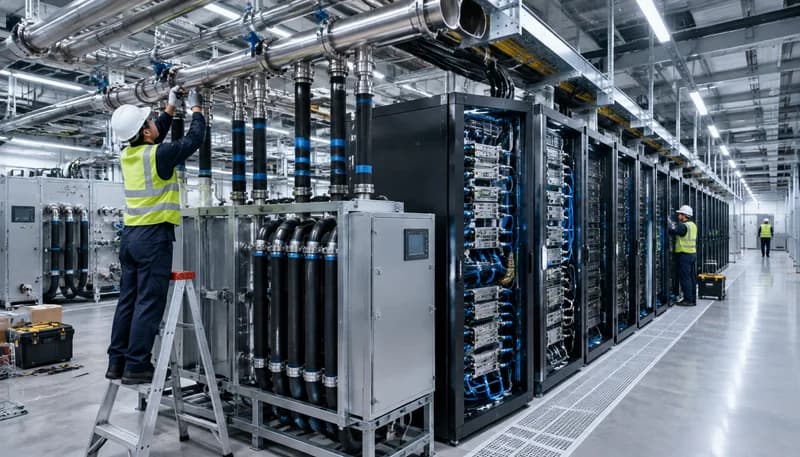
Thermal Transformation: Transitioning from Low-Density Air Cooling to Closed-Loop Propylene Glycol-Water Direct-to-Chip Systems
The original facility blueprint relied on traditional perimeter computer room air handlers (CRAH) designed for rack densities under 15kW, an architecture wholly inadequate for clusters utilizing modern dense accelerators. The thermal retrofit discards conventional air-side DX equipment in favor of a Direct-to-Chip (D2C) liquid cooling architecture. This system utilizes a closed-loop secondary fluid network circulating a 25% to 30% uninhibited or inhibited propylene glycol-water (PGW) solution. PGW optimizes heat transfer capacity while mitigating freeze risks during ambient winter excursions and providing dielectric and corrosion protection across multi-metal wetted loops.
Cooling Distribution Units (CDUs) deployed in an N+1 mechanical topology isolate the secondary loop from the primary facility water system. By operating the secondary loop at a standardized supply water temperature of 32°C to 35°C (ASHRAE W2/W3 operational window), the plant eliminates mechanical refrigeration during standard operational bands. Primary heat rejection is routed directly to closed-circuit adiabatic dry coolers, dramatically compressing facility water consumption and dropping annualized Power Usage Effectiveness (PUE) below 1.15. Secondary pumping systems are calibrated to provide 300 to 450 kPa differential pressure head, guaranteeing turbulence and optimum convective transfer across internal micro-channel cold plate designs.
Formulate closed-loop coolant with 25-30% industrial-grade inhibited propylene glycol with comprehensive corrosion-inhibitor packages (ASTM D1384).
Maintain secondary loop supply fluid temperatures at 32°C-35°C, ensuring full free-cooling operation via adiabatic dry coolers down to 35°C ambient dry-bulb.
Size CDU secondary pumps for 350 kPa differential pressure across rack headers, ensuring minimum turbulent flow (Re > 4000) within GPU cold plates.
Utility Power Staging & Substation Phasing: Navigating Munis (BTU) Capacity Interconnection and ERCOT Load Ramps
Integrating a 73MW concentrated computational load into the local electrical grid presents unique electrical engineering challenges. Operating within the footprint of Bryan Texas Utilities (BTU), a municipal power provider connected to the Electric Reliability Council of Texas (ERCOT) bulk transmission system, requires careful balancing between municipal capacity limits and state-level transmission constraints. Initial energization of the 18.25MW block demands a dual-fed 138kV-to-34.5kV substation transformer arrangement, stepping down facility distribution to 4.16kV for primary plant switchgear and 480V/415V for compute power trains.
High-performance AI model training runs create severe dynamic load ramps, generating step-load variations of 10MW to 40MW in fractions of a second during collective training checkpointing and compute phase transitions. Left unmitigated, these ramps cause severe frequency deviations and voltage sag across local municipal distribution feeders. The electrical infrastructure must integrate fast-response battery energy storage systems (BESS) or active load-smoothing solid-state DC links configured for sub-cycle response. Within the rack row, high-efficiency busways transition power directly to 48V or 800V DC internal power shelves, driving system electrical efficiency above 97.5% from transformer output to processor input.
Deploy dual redundant 138kV/34.5kV transformer substations with dedicated under-frequency load shedding (UFLS) relays coordinated with BTU/ERCOT.
Implement high-rate lithium-ion/supercapacitor dynamic load-smoothing modules capable of dampening >25MW/s compute step transients.
Transition white space power delivery to 415V AC primary lines feeding 48V/800V DC rack busbars, targeting a PDU-to-silicon efficiency exceeding 97.5%.
The Sovereign AI Architecture: Technical Frameworks for Verifiable Governance, Data Lineage, and FedRAMP/ITAR Enclaves
Operating an AI research and innovation center on a public university campus serving defense, healthcare, and energy sectors requires rigorous physical and digital tenant isolation. The campus implements a Sovereign AI framework that translates legal mandates into verifiable machine-level controls. Every compute node runs an integrated governance layer—enforced via low-level hypervisor agents and platform firmware—that monitors and cryptographically signs data access routines, hardware state integrity, and runtime workload boundaries. This ensures absolute custody over model weights, base training sets, and inference outputs.
Physical infrastructure is segmented into high-security enclaves adhering to ITAR physical containment directives and FedRAMP High baseline controls. Hardware Security Modules (HSMs) anchor the trust boundary, orchestrating confidential computing environments through AMD SEV-SNP or Intel TDX extensions. This architecture prevents facility administrators or physical intruders from exfiltrating cleartext data directly from memory channels or PCIe interconnects. Strict air-gapped zones are reinforced by dedicated optical fiber plants, compartmentalized biometric mantraps, and TEMPEST-grade RF shielding across designated defense innovation sectors.
Enforce cryptographically validated hardware root-of-trust (RoT) and Confidential Computing (SEV-SNP/TDX) across 100% of sovereign cluster nodes.
Deploy FedRAMP High and ITAR-compliant physical security layers, including biometric multi-factor mantraps and dedicated SCIF-grade physical enclaves.
Integrate automated data lineage auditing engines that map input tokens, weights, and memory buffers into tamper-evident immutability logs.
Mission-Critical Deployment Checklist: Power Availability Gates, CDU Redundancy (N+1), and Phased Commissioning
The commissioning of a distressed conversion facility must proceed under rigid, sequential phase-gate governance to de-risk investment capital against utility commitments. Commissioning agents must not energize high-density silicon clusters until mechanical, electrical, and control loops clear integrated systems testing (IST). Phasing gates link directly to verified MW drops provided by BTU, preventing stranded asset exposure if municipal grid buildouts lag internal fit-out timelines. Each 18.25MW module undergoes isolated level 1 through 5 commissioning protocols, validating performance prior to commercial interconnect.
Critical path commissioning centers on the liquid cooling distribution infrastructure. Closed loops must undergo hydrostatic pressure testing at 1.5 times the maximum allowable working pressure (MAWP), followed by chemical passivation and millipore particulate testing before engaging processor manifolds. CDU redundancy testing must prove seamless transfer under full 100kW+ rack thermal load: the loss of a lead CDU must trigger secondary unit ramp-up within 1.5 seconds without causing local thermal throttling on GPU cold plates. Automated Programmable Logic Controllers (PLCs) handling primary-to-secondary differential pressures must be load-tested against unexpected valve closures and flow cavitation scenarios.
Execute Level 4 and Level 5 Integrated Systems Testing (IST) using variable-load resistive load banks before mounting production GPU hardware.
Validate N+1 CDU failover response times under peak thermal load, verifying secondary coolant delta-T remains within +/- 1.5°C during transfer.
Implement a rigorous Phase-Gate authorization protocol tying capital expenditure and server integration directly to certified utility power delivery stages.
Engineering Procurement & Technical Desk
For technical datasheets, custom power topology design, or volume export quotations, reach out to HEFENGQI engineers.