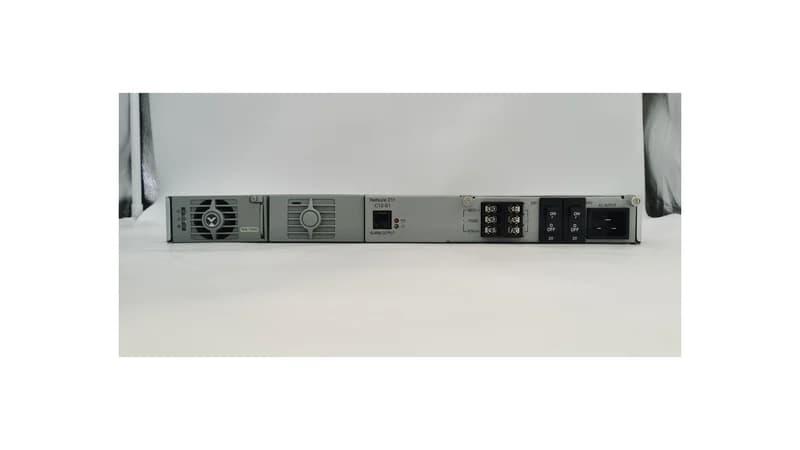
1. NetSure 211 C12-S1 Positioning and Electrical Architecture
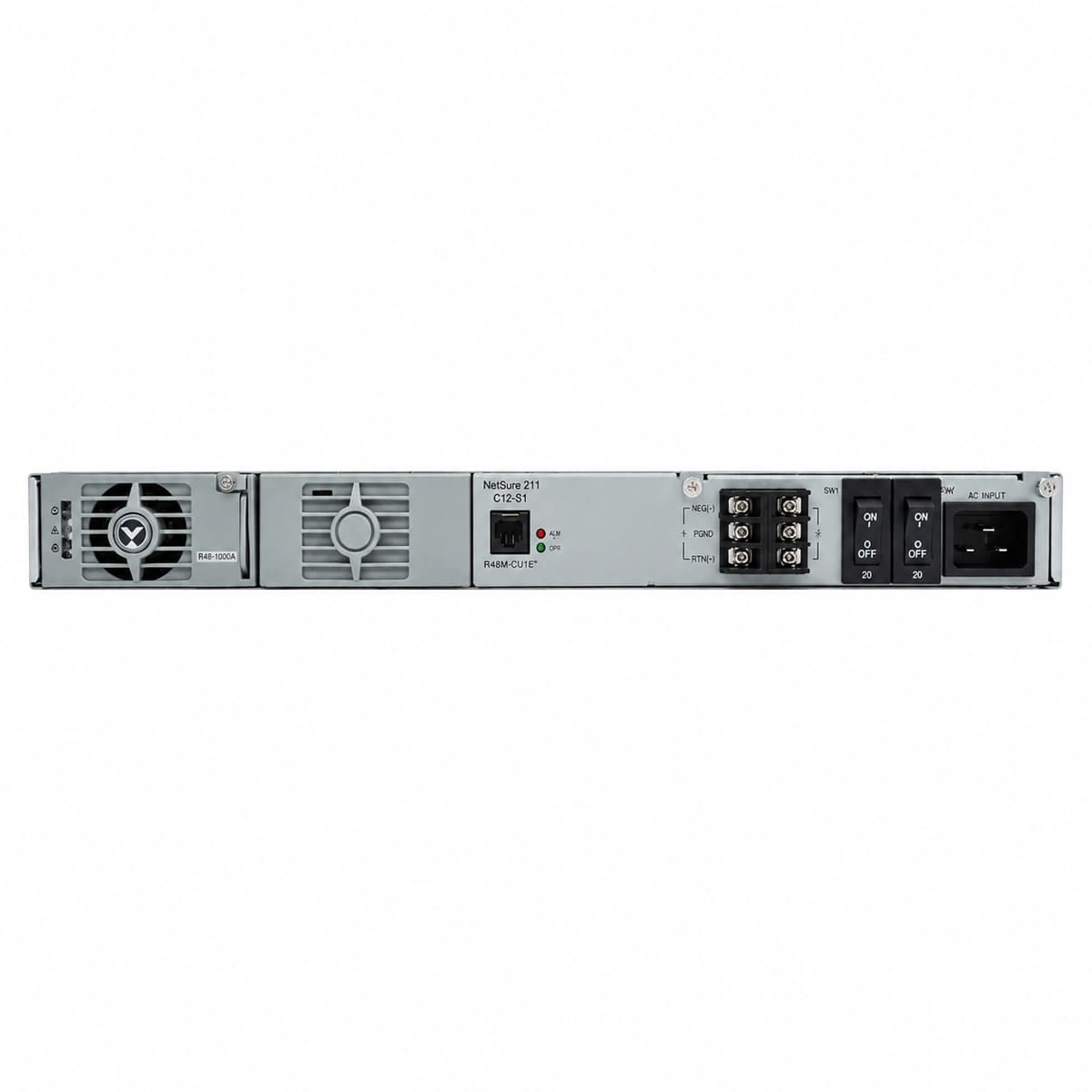
The Vertiv NetSure 211 series (formerly Emerson Network Power) is recognized as one of the most reliable ultra-compact embedded DC power platforms deployed in telecommunications access nodes, RRU/BBU outdoor enclosures, enterprise micro data rooms, and railway signaling networks. Within this portfolio, the NetSure 211 C12-S1 subrack occupies a compact 2U height (88 mm) with a standard 19-inch rack mounting width and a depth of approximately 300 mm. It delivers a nominal output voltage of -48V DC (adjustable between -42V DC and -58V DC) and a maximum rated DC output current of 120A (delivering approximately 6 kW to 7 kW under full rectifier load).
Electrically, the C12-S1 integrates an all-in-one chassis, hot-pluggable high-efficiency rectifiers, a centralized digital controller, and an integrated Power Distribution Unit (PDU). The system supports single-phase 220VAC or two-phase utility power inputs across an ultra-wide voltage window of 85VAC to 290VAC. It features comprehensive transient protection, including standard Class C/D surge protective devices (SPD) capable of handling nominal 20 kA lightning surges.
The front-access distribution bay incorporates physical isolation for battery strings and critical telecom loads with dual-stage disconnects (LLVD and BLVD). Designed to comply with CE, UL, and Telcordia NEBS Level 3 standards, the NetSure 211 C12-S1 is engineered for 24/7 mission-critical operations even in non-climate-controlled edge cabinets.
Rated Power Output: Nominal -48V DC busbar, maximum 120A capacity in a 2U subrack
Utility Grid Tolerance: 85VAC to 290VAC wide AC input range with integrated 20 kA surge suppression
Physical Form Factor: Standard 19-inch rack mount, 2U height (88 mm), 300 mm chassis depth with front-access layout
Safety Certifications: Full compliance with EN 55022 Class B EMC standards and Telcordia NEBS Level 3 reliability criteria
2. Rectifier Slot Topology, Controller Integration, and Distribution Architecture
The NetSure 211 C12-S1 chassis features three standardized blind-mate rectifier slots alongside a dedicated bay for the supervisory controller. The rectifier slots natively support hot-pluggable Vertiv modules, including the legacy eSure R48-1000 (20A / 1000W), R48-2000A3 (40A / 2000W), and the flagship high-efficiency R48-2000e3 (96.2% peak efficiency). Operating with three R48-2000e3 rectifiers, the system generates clean -48V DC power up to 120A while providing full N+1 or N+2 parallel redundancy.
System supervisory management is handled by Vertiv's M221S or M222S digital controllers. The controller communicates over an internal high-speed bus with each rectifier module, providing intelligent battery temperature compensation, automated periodic discharge tests, precision active current-sharing, shunt metering, and dry-contact alarm telemetry. It supports RS232, RS485, and optional SNMP network management interfaces.
The integrated DC distribution bay is engineered for high reliability. It incorporates dual battery input breakers (e.g., 2x 63A or 2x 100A MCBs) alongside separate load branches configured with Low Load Voltage Disconnect (LLVD for non-critical loads) and Battery Low Voltage Disconnect (BLVD for high-priority transmission and core routers), preventing deep battery discharge during prolonged grid outages.
Rectifier Bays: 3x 1U standard hot-swap slots compatible with R48-1000, R48-2000A3, and R48-2000e3
Supervisory Unit: M221S digital controller or M222S with LCD interface and remote network reporting
Dual-Stage LVD Architecture: Independent LLVD and BLVD contactors ensuring core service survivability
DC Distribution MCB Array: Front-accessible circuit breakers for battery strings and prioritized DC feed branches
3. Retrofit Strategies for Legacy Sites and Capacity Upgrades
In brownfield telecom infrastructure revamps, aging legacy power subracks such as the Emerson PS48120-2/1800 and PS4860 frequently encounter component degradation, clogged airflow passages, dried electrolytic capacitors, and obsolete spare parts. The NetSure 211 C12-S1 provides a direct form-factor replacement for these legacy 2U and 3U subracks, matching existing cabinet mounting rails and cable routing paths without requiring metalwork modifications.
When upgrading rectifier efficiency, migrating from older 91% efficient R48-1800 or R48-2000A3 modules to the modern eSure R48-2000e3 boosts total conversion efficiency beyond 96%. This transition cuts thermal dissipation by more than 40%, significantly alleviating heat accumulation inside unventilated outdoor street cabinets.
Before completing a full capacity expansion up to 120A, field engineers must verify the upstream AC circuit breaker rating (upgrading from 25A to 40A or 63A as required) and ensure the AC supply cable cross-section meets minimum standards (6 mm2 to 10 mm2). The controller settings must be updated via the M221S interface to match the revised battery capacity and overall current limit setpoints.
Direct Mechanical Retrofit: 1-to-1 form-factor replacement for legacy Emerson PS48120/1800 and PS4860 subracks
High-Efficiency Upgrade: In-place migration to R48-2000e3 rectifiers reduces system thermal waste by over 40%
Upstream Power Verification: Confirm AC feed breakers and cabling ampacity before commissioning 120A full loads
Controller Calibration: Recalibrate shunt multipliers and battery charging profiles via M221S console
4. Counterfeit Detection and Refurbished Subrack Identification
Given the substantial global demand for NetSure 211 components in edge networks, the secondary market contains numerous decommissioned units, repainted chassis, and unauthentic internal distribution assemblies. Substandard refurbished subracks introduce risks of loose busbar arcing, contactor welding, unmonitored battery runaway, and potential electrical fires. Buyers must inspect four critical areas:
First, examine the sheet metal stamping and powder coating. Authentic Vertiv factory chassis use high-precision electro-galvanized cold-rolled steel with an electrostatic fine-particle powder coat that resists scratches and peeling. Refurbished frames frequently exhibit uneven spray paint over corroded metal, peeling finishes around ventilation cutouts, and stripped screw threads.
Second, inspect the DC disconnect contactors and internal copper busbars. Genuine units feature certified German or multinational high-grade DC contactors with magnetic blowout arc suppression, paired with thick, high-purity tin-plated copper busbars. Low-grade rebuilds often swap these with inferior contactors or undersized brass bars prone to dangerous overheating.
Third, verify the rear blind-mate backplane connectors. Genuine backplane receptacles use gold-plated phosphor bronze spring pins that maintain consistent contact pressure. Refurbished units commonly show heat discolouration, burnt pin tips, or fatigued leaves that cause intermittent communication loss and current imbalance.
Fourth, inspect official barcodes and traceability labels. Authentic NetSure 211 C12-S1 subracks carry tamper-evident barcode labels displaying matching Serial Numbers (SN) and Part Numbers that correspond to Vertiv's manufacturing batch records.
Chassis Finish Inspection: Electrostatic factory powder coating without overspray, rust pitting, or re-tapped holes
Busbar and Contactor Quality: Heavy-gauge tin-plated copper busbars and authentic branded DC contactors
Backplane Pin Condition: Bright gold-plated connectors free from electrical pitting, oxidation, or loose spring fingers
Label and Traceability Match: Matching SN and Part Number barcode tags aligned with official factory dispatch records
5. Critical Electrical and Physical Specifications Summary
To support engineering design and procurement evaluations, the key electrical and mechanical parameters of the NetSure 211 C12-S1 system are summarized below:
For continuous telecom loads operating between 40A and 80A, installing two R48-2000e3 modules provides reliable N+1 redundancy. For continuous loads between 80A and 100A, three rectifiers should be deployed to safeguard continuous power delivery during module servicing. The battery charging current limit must be configured based on the total battery bank capacity (typically 100Ah to 300Ah VRLA or lithium-ion configurations).
Input Supply: Single-phase 220VAC / two-phase, operating window 85VAC to 290VAC (45 Hz to 65 Hz)
System Capacity: -48V DC / 120A rated output current (up to 7000W with three rectifiers)
Modular Rectifier Slots: 3x 1U bays supporting R48-1000, R48-2000A3, or R48-2000e3
Integrated Distribution: 2x battery breakers (63A to 100A), 2x BLVD priority feeds, 4x LLVD non-critical feeds
Operating Temperature: -40 deg C to +75 deg C (linear derating above 55 deg C), relative humidity 5% to 95% non-condensing
6. RICEWIND Quality Verification and Worldwide Supply Capabilities
As a specialized international provider of mission-critical telecom and industrial power infrastructure, RICEWIND maintains ready stocks of brand-new and certified Grade A+ power subracks, rectifier modules, and controllers from Vertiv, Huawei, ZTE, Delta, and Eltek. Every NetSure 211 C12-S1 unit dispatched from our engineering facility completes an exhaustive 100% full-load quality assurance protocol:
Our testing procedure includes: 1) Dynamic full-range AC voltage sweep from 85VAC to 290VAC under varying line conditions; 2) 4-hour continuous burn-in at full 120A rated capacity with infrared thermal imaging across all internal copper busbars and contactor joints; 3) M221S/M222S controller communication verification, shunt sensor calibration, and dry-contact alarm telemetry testing; 4) Low-voltage disconnect simulation for both LLVD and BLVD contactor trip and reset thresholds; 5) Hi-Pot dielectric insulation testing (2120VDC / 3000VAC). Every unit is packaged with anti-static shielding and custom-fitted high-density polyethylene foam for international delivery via DHL, FedEx, UPS, air cargo, and ocean freight.
For project engineering drawings, custom DC breaker configurations, or procurement quotations, please contact RICEWIND engineering: Email: lee@ricewind.com | Phone / WhatsApp: +86 17621197907.
100% Full-Load Burn-In: 4-hour continuous 120A operation with infrared thermal validation across all electrical joints
Dual-Stage LVD Verification: Calibrated trip and re-engage voltage testing for LLVD and BLVD contactors
Dielectric Safety Testing: Insulation resistance exceeding 10 Mohm with 2120VDC dielectric testing
Heavy-Duty Export Packaging: Moisture-proof barrier bags and custom molded shock-absorbing foam for global transport
Engineering Procurement & Technical Desk
For technical datasheets, custom power topology design, or volume export quotations, reach out to HEFENGQI engineers.