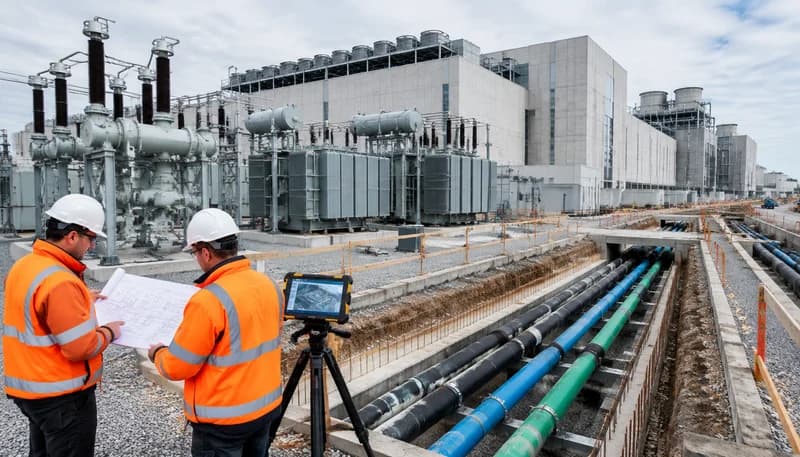
The Sunset of Single-Variable Site Selection: Power Exclusivity to Tri-Faceted Scrutiny
Between 2021 and 2025, hyperscale and enterprise site selection operated on a deterministic, single-variable calculus: locate available bulk electric transmission capacity and secure an executed interconnection study. Driven by the exponential growth of dense artificial intelligence clusters demanding tens to hundreds of megawatts per campus, developers accepted geographic isolation, protracted permitting timelines, and sub-optimal municipal relationships as long as the Electric Service Agreement delivered energized substation capacity. That unipolar approach has experienced structural failure across North American and European power markets. Public utility commissions, municipal assemblies, and regional transmission operators have formed a unified regulatory front that treats utility-scale compute loads not as conventional industrial assets, but as systemic disruptions to municipal welfare, water basin hydrology, and regional ratepayer economics.
Regulatory actions across major compute corridors—including California, Texas, New York, Massachusetts, and the Mid-Atlantic—demonstrate that power availability without verified socio-hydrological equilibrium is a fatal project defect. Statehouses have erected interconnected administrative barriers that halt facilities despite executed power supply contracts. In this operating environment, site selection must be treated as a tri-faceted vector optimization problem: capital ring-fencing for utility transmission infrastructure, verifiable zero-evaporation or reclaimed hydrological topologies, and binding, multi-million-dollar host community infrastructure co-development. Projects attempting to advance solely on bilateral utility interconnection letters now face mid-construction moratoriums, environmental permit disqualifications, and punitive legislative interventions.
Audit existing pipeline portfolios to identify facilities permitted under legacy single-variable criteria that lack municipal host agreements or non-potable water allocations.
Integrate cross-functional site scoring algorithms that weight hydrological stress indices and local legislative pushback equally with electric transmission availability.
Establish regional political-regulatory risk registries for every prospective substation node prior to submitting formal System Impact Study deposits.
Front One: Grid Interconnection Capital Allocation & Ratepayer Protection Firewalls
The first front centers on eliminating utility cost-socialization. Historically, transmission operators and investor-owned utilities rolled the capital expenditures for network upgrades, tap lines, high-voltage breaker expansions, and dynamic reactive support into aggregate rate bases, distributing these carrying costs across the general residential and commercial ratepayer base. State regulators have permanently severed this arrangement. California's legislative triumvirate—AB 1577, AB 2383, and SB 887—now legally obligates large compute operators to absorb one hundred percent of the incremental capital expenditure required to interconnect, construct, and firm their electrical service. These statutes establish strict balance-sheet firewalls protecting low- and middle-income ratepayers from bearing grid upgrade costs, while Massachusetts Executive Order 658 mandates that facilities exceeding 25 MW fund dedicated ratepayer protection mechanisms if behind-the-meter or contracted clean generation targets fall short.
Simultaneously, regional market regulators are moving from passive cost tracking to aggressive contract scrutiny and tariff adjustments. The Alabama Public Service Commission now forces electric utilities to demonstrate full incremental cost recovery before executing large-load Power Purchase Agreements, while the Pennsylvania Public Utility Commission is reshaping large-load tariffs and emergency demand-curtailment rules to resolve systemic PJM capacity shortfalls. In the Pacific Northwest, large industrial consumers operating under Portland General Electric are absorbing approximate 29% tariff surges under Oregon's POWER Act to offset massive network reinforcements. Consequently, financial pro formas must account for multi-year capital escrow accounts, dedicated facility-funded transmission asset construction, and bilateral capacity-reservation arrangements that isolate utility retail customers from capacity market volatility.
Structure all Power Purchase Agreements and Interconnection Agreements with explicit capital contribution-in-aid-of-construction schedules and non-socialized cost allocations.
Conduct independent regulatory compliance audits under regional frameworks such as Oregon's POWER Act and Massachusetts EO 658 before signing binding utility tariff commitments.
Model balance-sheet impacts of mandatory letter-of-credit or escrow mechanisms designed to protect low-income residential ratepayers against stranded transmission asset risks.
Front Two: Water Rights, Hydrological Stress & Zero-Evaporation Cooling Mandates
The thermodynamic realities of high-density AI acceleration have elevated water consumption into an immediate statutory vulnerability. Space cooling across legacy hyperscale data center footprints can be up to 2.9 times as energy-intensive as baseline commercial real estate, and when operators manage thermal dissipation through evaporative wet cooling towers, millions of gallons of potable water are consumed daily per campus. In response, water stress has shifted from an operational efficiency metric (Water Usage Effectiveness, or WUE) into a firm statutory permitting gate. In Texas, the governor's office directed the Texas Commission on Environmental Quality to freeze facility permits pending Electric Reliability Council of Texas grid reviews, while charging the Texas Water Development Board with prosecuting non-compliant facilities and revoking state water appropriations for operators failing to submit rigorous hydrological disclosures.
A parallel statutory tightening is underway in coastal and arid zones alike. California mandates exhaustive upfront disclosures to local water districts regarding potable draw, thermal rejection volumes, and multi-year drought contingencies before grading permits can be considered, often conditioning municipal approvals on developer-financed wastewater plant modernizations. New Jersey's S 3379 has codified mandatory, semiannual reporting of facility water and energy consumption to the Board of Public Utilities. Facilities relying on open-loop or wet evaporative topologies face severe statutory exposure, municipal litigation, and public extraction caps. Environmental permitting teams must now design cooling topologies to meet baseline WUE targets near 0.00 m3/MWh using potable sources, treating dry, closed-loop, or industrial-reclaimed water architectures as compulsory baseline standards.
Eliminate evaporative wet-cooling systems relying on municipal potable water from all baseline conceptual designs for sites in basins with medium-to-high hydrological stress.
Establish formal compliance protocols to fulfill statutory semiannual energy and water disclosures under frameworks such as New Jersey S 3379 and Texas Water Development Board mandates.
Perform localized hydrogeological aquifer depletion assessments and municipal wastewater treatment capacity studies during phase-one due diligence.
Front Three: Host Community Investment Benchmarks & Municipal Co-Development
The third front dissolves the historical isolation of data center parcels from municipal civic planning. Historically characterized by low permanent on-site employment density relative to physical scale, data centers are increasingly viewed by local municipal councils as high-impact consumers of municipal land and natural resources that yield insufficient community utility. To eliminate this point of friction, state governments are deploying structured economic frameworks. New York's Host Community Investment Framework sets an explicit target of $1 million per megawatt of utility demand for local community benefit agreements. This benchmark establishes an economic baseline for local capital expenditures across regional transportation, water and sewer district recapitalization, emergency services modernization, workforce housing funds, and public school endowments.
Simultaneously, states are dismantling procedural loopholes that previously protected developers from rigorous local planning disputes. California SB 887 systematically stripped data centers of broad, fast-tracked environmental exemptions, requiring comprehensive environmental impact reviews and strict compliance with local zoning standards before any accelerated judicial reviews can proceed. Municipal host negotiations are no longer peripheral transactional exercises handled at the close of zoning approvals; they dictate baseline project viability. Developers must formulate proactive co-development agendas that provide localized district heating, public utility interconnects, and long-term tax stabilizing covenants, effectively converting the physical facility into an anchor tenant for regional infrastructure rehabilitation.
Calculate Host Community Agreement capital budgets using New York's $1,000,000 per megawatt standard as a baseline contingency metric for project financial modeling.
Conduct thorough CEQA and NEPA compliance reviews, explicitly verifying that local environmental exemptions are not invalidated by statutes such as California SB 887.
Establish legally binding Community Benefits Agreements that address road restoration, emergency services apparatus financing, and wastewater district upgrades prior to zoning board hearings.
Front Four: Integrated Infrastructure Engineering: Microgrids, Closed-Loop Loops & Wastewater Utilization
Navigating this three-front regulatory matrix requires moving away from conventional utility topologies and adopting advanced, multi-system plant engineering. To isolate regional ratepayers from interconnection costs and insulate facilities against capacity shortfalls, developers are engineering behind-the-meter microgrid networks. These hybrid installations integrate reciprocating internal combustion engines optimized for low-carbon fuels, utility-scale lithium-iron-phosphate (LFP) battery energy storage systems, and collocated solar or geothermal assets. Operating behind-the-meter allows campuses to perform peak-shaving, dynamic frequency regulation, and automated dispatch into wholesale capacity markets during grid emergencies, turning the compute cluster from a passive grid burden into a resilient operational asset.
Thermodynamically, facility architectures are being completely redesigned to eliminate potable water consumption while supporting thermal design power (TDP) thresholds exceeding 1,000 watts per processor socket. High-density AI deployments utilize two-phase immersion systems or closed-loop direct-to-chip liquid cooling loops operating alongside adiabatic dry coolers equipped with variable-speed electronically commutated fans. When thermal management requires external liquid media, advanced systems rely on tertiary-treated municipal effluent or industrial reclaimed gray water, supported by dedicated on-site reverse osmosis and multi-stage filtration plants. By decoupling heat rejection from the municipal potable supply, operators satisfy state water preservation statutes while insulating internal hardware from local drought-driven curtailment orders.
Engineer closed-loop direct-to-chip or immersion cooling systems paired with dry coolers to maintain a non-potable Water Usage Effectiveness under 0.05 m3/MWh.
Deploy on-site industrial gray water and tertiary wastewater treatment systems to eliminate facility dependence on the local municipal potable water supply.
Incorporate behind-the-meter battery energy storage systems and low-carbon dispatchable power to provide dynamic peak shaving and fast-start grid contingency support.
Front Five: Strategic Site-Selection & Compliance Framework for Gigawatt-Era AI Facilities
As compute installations scale toward gigawatt-scale AI campuses, infrastructure procurement must transition from disjointed real estate transactions into an integrated engineering and regulatory lifecycle. Modern site acquisition mandates a simultaneous three-stage audit. First, power engineering teams must engage directly with transmission operators to run dynamic power-flow and short-circuit models that confirm non-socialized interconnection costs, network headroom, and transformer manufacturing lead times. Second, hydrological consultants must assess watershed resilience, aquifer drawdown trajectories, and municipal wastewater effluent volumes, ensuring that cooling requirements can withstand persistent drought declarations without triggering emergency operating cutbacks.
Finally, municipal engagement teams must initiate parallel discussions with local stakeholders, using formal co-investment models to align project delivery with civic objectives. This requires presenting integrated infrastructure models showing how the campus funds local substation upgrades, supplies low-grade waste heat to municipal district heating networks or commercial agriculture, and commits capital through binding Host Community Agreements. By front-loading regulatory compliance, water conservation engineering, and civic economic alignment directly into site-scoring frameworks, developers can de-risk multi-billion-dollar balance-sheet allocations, bypass protracted administrative delays, and bring critical compute capacity online ahead of regional moratorium deadlines.
Institute a three-stage gating framework that checks power transmission cost allocations, hydrological limits, and municipal agreements before purchasing land.
Implement thermal waste-heat recovery interfaces to export liquid loop thermal energy to adjacent district heating, agricultural, or industrial applications.
Establish unified project execution teams integrating high-voltage electrical engineers, industrial hydrologists, and regulatory municipal strategists from day one.
Engineering Procurement & Technical Desk
For technical datasheets, custom power topology design, or volume export quotations, reach out to HEFENGQI engineers.